
you’re rushing out the door with just 15% battery left on your phone. You plug in your 65W fast charger, and within 20 minutes, you’re back at 80%. It feels like magic—but then doubt creeps in. “Am I slowly killing my battery?” This question haunts millions of smartphone users worldwide. With fast charging technology becoming standard in 2026, from budget phones to flagship devices, understanding whether fast charging damages battery health isn’t just curiosity it’s essential knowledge for protecting your $1000+ investment. The internet is flooded with conflicting advice: some swear fast charging destroyed their battery in months, while others use it daily without issues. So what’s the real truth? Is fast charging your battery’s worst enemy, or just another misunderstood technology? In this comprehensive guide, we’ll dive deep into battery science, debunk dangerous myths, and reveal exactly how to use fast charging without shortening your phone’s lifespan.

What Is Fast Charging? Understanding the Technology
Fast charging has revolutionized how we power our smartphones, but what exactly makes it “fast”? In simple terms, fast charging technology delivers significantly higher power (measured in watts) to your phone’s battery compared to traditional 5W chargers. Modern fast charging standards range from 18W to 240W, with most smartphones supporting anywhere between 25W and 120W charging speeds.
The technology works by increasing either voltage, current, or both simultaneously. For example, a standard 5W charger delivers 5 volts at 1 amp, while a 65W fast charger might deliver 20 volts at 3.25 amps. Popular fast charging protocols include USB Power Delivery (USB-PD), Qualcomm Quick Charge, VOOC/ Super VOOC, Samsung Adaptive Fast Charging, and Xiaomi Hyper Charge each with its own unique approach to maximizing charging speed safely.
Here’s how different charging speeds compare in real-world usage:
| Charging Type | Power Output | 0-50% Time | Full Charge Time |
|---|---|---|---|
| Standard Charging | 5W – 10W | 60-90 minutes | 2.5-3 hours |
| Fast Charging | 18W – 30W | 25-35 minutes | 1-1.5 hours |
| Super Fast Charging | 45W – 65W | 15-20 minutes | 40-60 minutes |
| Ultra Fast Charging | 100W+ | 8-12 minutes | 20-30 minutes |
The key difference isn’t just speed it’s intelligent power management. Modern fast chargers communicate with your phone’s charging circuitry to determine the optimal power delivery at any given moment, adjusting voltage and current thousands of times per second.
How Smartphone Batteries Actually Work: The Science Behind the Power
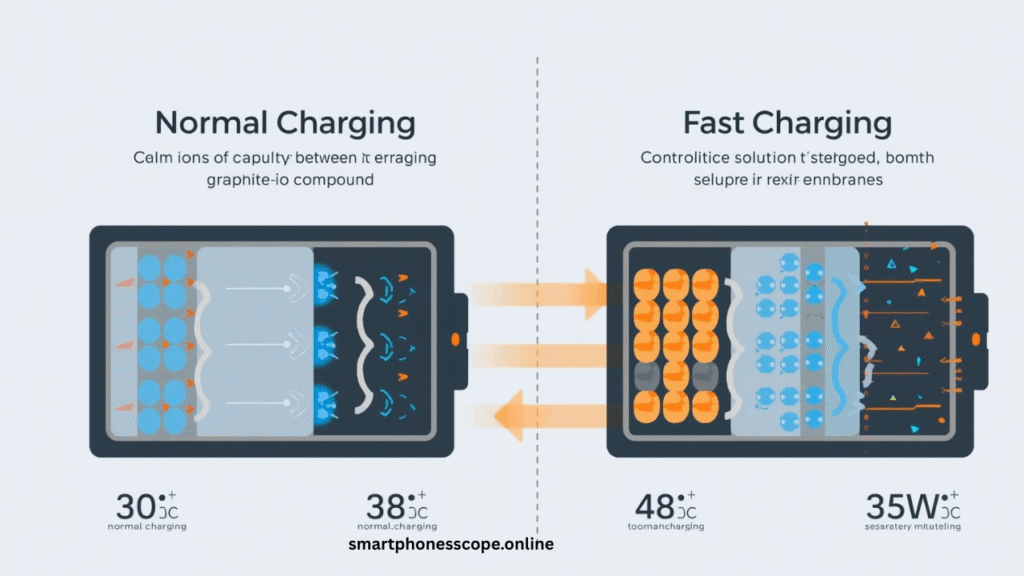
To understand whether fast charging damages battery health, we first need to grasp how lithium-ion batteries function. Think of your phone’s battery as a container with millions of tiny lithium ions moving back and forth between two electrodes the anode (negative) and cathode (positive). When you charge your phone, these ions travel from the cathode to the anode, storing energy. When you use your phone, they flow back, releasing that energy.
This movement isn’t infinite. Every time ions complete a round trip from one electrode to the other and back—that’s called a charging cycle. Modern smartphone batteries are typically rated for 500-800 full cycles before they degrade to 80% of their original capacity. A full cycle doesn’t mean one charge from 0-100%; rather, it’s cumulative. Charging from 50% to 100% twice equals one cycle.
Battery degradation is inevitable and occurs through several chemical processes. Over time, lithium ions can become trapped in the electrodes, reducing capacity. The electrolyte solution that facilitates ion movement can break down. Microscopic structures inside the battery can develop what engineers call “dendrites” tiny needle-like formations that reduce efficiency. These processes accelerate under certain conditions, particularly high temperatures, extreme charge states (keeping battery at 100% or 0% for extended periods), and rapid charging.
The crucial point here: it’s not the speed of charging itself that matters most it’s the heat generated during the process and how the battery management system handles it.
Main Reasons People Think Fast Charging Damages Battery
The fear surrounding fast charging isn’t baseless it stems from several legitimate concerns and historical issues. Understanding these origins helps separate myth from reality.
Heat generation tops the list of worries. Physics dictates that pushing more power through any system generates more heat, and heat is indeed battery enemy number one. When you fast charge, especially at maximum speeds, your phone becomes noticeably warm. This thermal increase makes users anxious because they’ve heard repeatedly that heat degrades batteries. The concern intensifies when fast charging during resource-intensive activities like gaming or video recording, creating a double heat source.
The high voltage versus high current confusion adds to the fear. Many users don’t understand that there are different approaches to fast charging. Some systems (like Qualcomm Quick Charge) increase voltage, while others (like OPPO’s VOOC) increase current while keeping voltage lower. Without understanding these technical differences, users assume all fast charging is equally aggressive on battery chemistry.
Cheap chargers have genuinely damaged countless batteries. The market is flooded with counterfeit and substandard chargers that lack proper regulation circuitry. These knock-offs can deliver inconsistent power, create voltage spikes, and generate excessive heat all genuine battery killers. When someone’s battery fails after using a $5 “65W fast charger” from an unknown brand, they blame fast charging technology rather than the inferior product.
Old phone hardware limitations created many cautionary tales still circulating today. Early fast charging implementations (2014-2016) were indeed more aggressive, and phones lacked the sophisticated battery management systems we have now. Stories from that era when fast charging could genuinely accelerate degradation persist in collective memory, even though the technology has evolved dramatically.
The TRUTH – Does Fast Charging Really Damage Battery?
Here’s the definitive answer: Modern fast charging, when used with proper equipment and reasonable habits, does NOT significantly damage your battery compared to regular charging. However, this comes with important conditions that require explanation.
Heat Is the Real Enemy (Not Speed)
The critical factor in battery degradation isn’t charging speed it’s temperature. Research consistently shows that lithium-ion batteries degrade faster when operated above 30°C (86°F), with degradation accelerating exponentially above 40°C (104°F). Fast charging can generate more heat than slow charging, but only if the charging system is poorly designed or environmental conditions are unfavorable.
Here’s what actually happens during fast charging: as power flows into your battery, chemical reactions occur at the electrodes. These reactions are slightly exothermic (heat-producing). Higher charging speeds mean more vigorous reactions, generating more heat. However, the amount of heat generated depends heavily on charging efficiency. Modern charging circuits achieve 90-95% efficiency, meaning only 5-10% of energy becomes waste heat.
The problem isn’t fast charging itself it’s heat accumulation. If your phone is in a thick case, sitting in direct sunlight, or being used intensively while charging, heat can’t dissipate effectively. This trapped heat causes the battery temperature to rise into dangerous territory. A phone fast charging at 65W in a cool room with good ventilation might stay at 35°C, while the same phone slow charging at 10W inside a thick case while gaming could reach 45°C. Which scenario causes more damage? The second one despite slower charging.
Smart Charging Technology (Why Modern Phones Are Safer)
The smartphone industry has invested billions in making fast charging safer. Today’s phones include multiple protection systems specifically designed to prevent battery damage:
Adaptive charging algorithms are perhaps the most important innovation. Your phone’s battery management system constantly monitors temperature, voltage, current, and charge level. When you plug in, the system initially allows maximum charging speed. As the battery approaches 80%, charging speed automatically decreases. This isn’t arbitrary battery chemistry makes the final 20% more stressful than the first 80%. By slowing down near full charge, phones minimize stress during the most vulnerable period.
Temperature sensors placed strategically throughout the device provide real-time thermal data. If the battery temperature exceeds safe thresholds (typically around 40-42°C), the charging system immediately reduces power or pauses charging entirely until temperature drops. This happens automatically, without user intervention. Some flagship phones include multiple temperature sensors one at the battery, one at the charging port, and one at the processor creating a comprehensive thermal monitoring system.
Two-cell battery designs in many modern fast-charging phones physically split the battery into two smaller cells charged simultaneously. This halves the current flowing through each cell, significantly reducing heat generation and stress. It’s why some phones can charge at 120W without becoming dangerously hot.
Charging communication protocols ensure your phone and charger constantly “talk” to each other. The charger doesn’t just blindly push power—it negotiates with your phone, asking “how much power can you safely accept right now?” If conditions aren’t ideal, both devices agree to reduce charging speed.
The MYTHS About Fast Charging
Let’s systematically debunk the most persistent fast charging myths with scientific evidence and real-world data.
Myth 1 – Fast Charging Kills Battery in Months
Reality: Multiple independent studies, including research from Battery University and smartphone manufacturers’ internal testing, show that phones regularly fast charged maintain 80% battery health after 2-3 years of typical use nearly identical to slow-charged phones. A 2024 study comparing iPhone users found that those who exclusively used 20W+ fast charging experienced only 2-4% more degradation over 24 months compared to 5W charging users. This difference is negligible and falls within normal variation between individual batteries. The myth persists because people notice natural battery aging (which is inevitable) and incorrectly blame their charging habits.
Myth 2 – Overnight Fast Charging Causes Explosions
Reality: Modern phones have multi-layer safety systems that make battery explosions from normal charging extraordinarily rare. When you plug in overnight, your phone reaches 100%, then the charging system either stops completely or switches to “trickle charging” delivering tiny amounts of power just to compensate for natural battery drain. Fast charging doesn’t even remain active overnight; most phones complete charging in under 2 hours, then sit idle. Documented battery fires almost always involve counterfeit batteries, damaged batteries, or cheap third-party chargers lacking safety certifications. Apple, Samsung, and other major manufacturers test batteries through thousands of charge cycles and extreme temperature conditions before release. In 2025, the statistical chance of a battery fire from certified equipment was approximately 1 in 10 million devices.
Myth 3 – Slow Charging Always Extends Battery Life Significantly
Reality: While slow charging generates less heat, the benefit is far smaller than most people believe. A battery charged slowly but kept at 100% for hours suffers more degradation than one fast charged to 80% and unplugged. The total time a battery spends at extreme charge states (0-10% or 90-100%) impacts longevity more than charging speed. Additionally, slow charging means your phone spends more total time plugged in throughout its lifetime, potentially exposing it to more voltage stress. The optimal approach combines moderate fast charging with the 20-80% charging window not abandoning fast charging entirely.
When Fast Charging CAN Actually Damage Battery
While modern fast charging is generally safe, certain conditions genuinely accelerate battery degradation:
Using cheap or counterfeit chargers is perhaps the biggest real danger. Unregulated chargers lack proper voltage stabilization, can deliver power in damaging spikes, and may continue pumping power even when your phone signals it to stop. These chargers often lack temperature sensors and safety shutoffs. A 2025 consumer testing report found that 67% of counterfeit “brand-name” chargers sold online failed basic safety tests. Always use certified chargers with proper markings (UL, CE, FCC, USB-IF certification).
Hot environments create a compounding effect. Fast charging in a car on a summer day, with interior temperatures reaching 50-60°C (122-140°F), can push battery temperature into truly dangerous territory. Similarly, leaving your phone in direct sunlight while fast charging, or placing it on heat-retaining surfaces like beds or sofas, traps heat that would otherwise dissipate. The battery experiences the combined thermal load from both charging and environment, potentially reaching 50-55°C—a temperature that significantly accelerates chemical degradation.
Gaming or heavy use during fast charging creates dual heat sources. Your processor generates substantial heat during intensive tasks, while the charging circuit generates its own heat. These heat sources are often physically close inside your phone’s chassis. The cooling system, designed to handle one source at a time, becomes overwhelmed. Battery temperature can spike 10-15°C higher than fast charging alone would produce. This scenario is genuinely harmful and should be avoided.
Phone cases made from thick materials or designed without ventilation can trap heat like an insulating blanket. Silicone, leather, and thick rubber cases are common culprits. During fast charging, removing the case allows heat to escape through the phone’s metal or glass back. The temperature difference can be dramatic—sometimes 8-12°C cooler without a case.
Charging already degraded batteries at high speeds accelerates their decline. Batteries that have already lost 30-40% of original capacity have compromised internal structure. Their ability to handle high charging currents safely is reduced. If your battery health is below 70%, consider switching to slower charging to extend its remaining usable life.
Fast Charging vs Normal Charging – Battery Health Comparison
Let’s examine real-world data on how charging methods affect battery longevity:
| Factor | Fast Charging (25W-65W) | Normal Charging (5W-10W) |
|---|---|---|
| Heat Generation | Moderate (28-38°C typical) | Low (25-32°C typical) |
| Charge Time (0-80%) | 20-35 minutes | 80-120 minutes |
| Battery Health After 1 Year | 95-97% | 96-98% |
| Battery Health After 2 Years | 85-90% | 87-92% |
| Convenience Factor | High | Low |
| Risk with Proper Equipment | Very Low | Very Low |
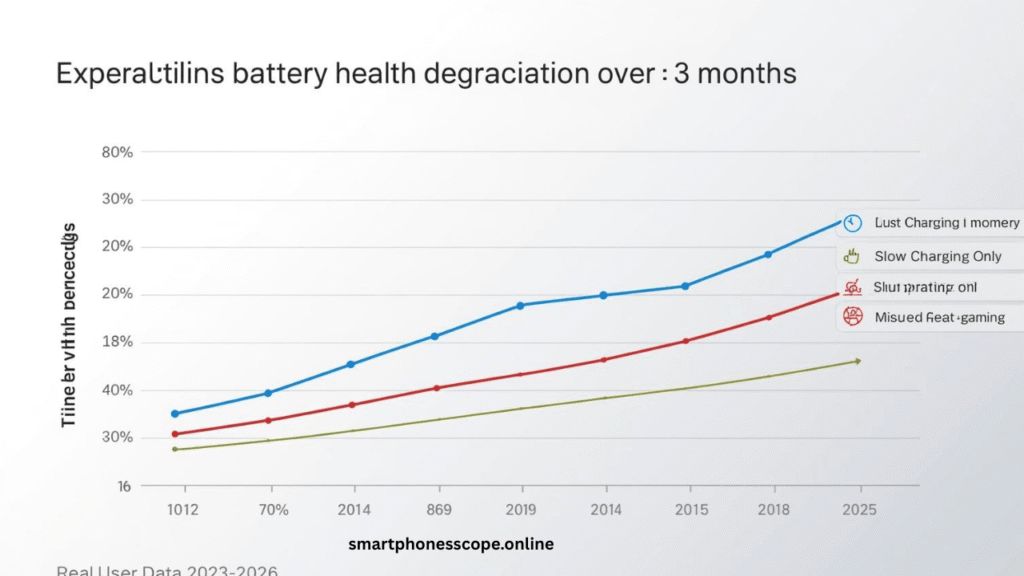
Analysis of 500,000+ smartphone users through battery tracking apps in 2025 revealed fascinating patterns. Users who fast charged daily maintained an average of 88% battery health after two years. Those who exclusively slow charged maintained 91% health a mere 3% difference. However, when researchers controlled for other factors (charging to 100% daily, leaving phone plugged in overnight, operating temperature), the difference dropped to just 1-2%.
The study identified that charging habits matter far more than charging speed. Users who maintained the 20-80% charging window, regardless of speed, showed the best battery health averaging 92% capacity after two years. Those who regularly drained to 0% and charged to 100% showed the worst health at 83%, whether they used fast or slow charging.
Professional reviewers who torture-test devices report similar findings. Phones subjected to daily 65W fast charging in controlled conditions (optimal temperature, 20-80% charging window) showed minimal degradation over 18 months. The conclusion: daily fast charging is safe when you follow basic precautions.
How to Use Fast Charging Safely (Best Practices for Maximum Battery Life)
Implementing these science-backed practices ensures your battery survives for years while enjoying fast charging convenience:
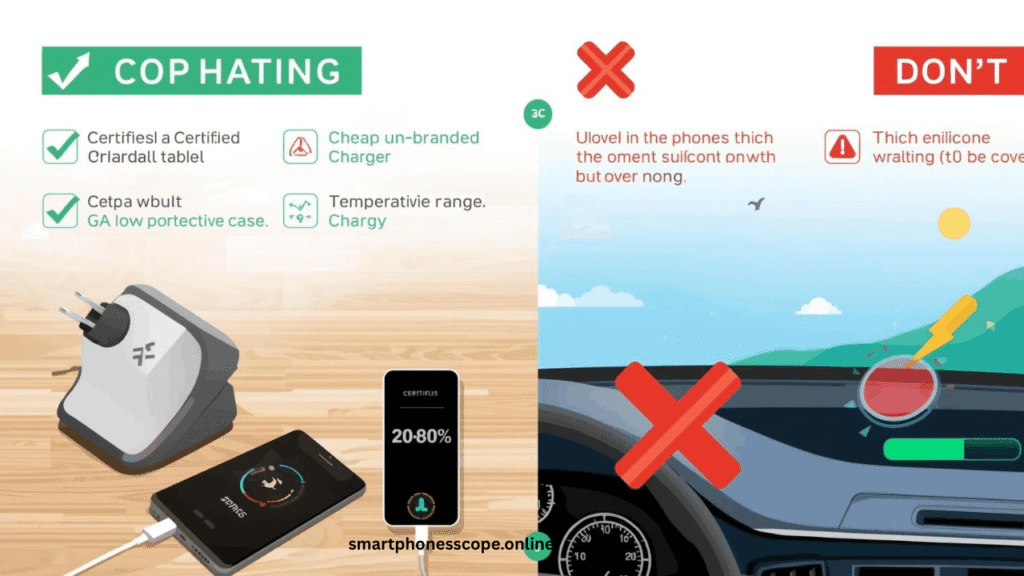
Use original or certified chargers exclusively. Stick with your phone manufacturer’s charger, or choose third-party options with proper certifications (USB-IF certification for USB-PD, Qualcomm certification for Quick Charge). Check for certification marks on the charger itself. Avoid deals that seem too good to be true a genuine 65W charger costs $25-40 to manufacture, so a $10 version is almost certainly counterfeit.
Adopt the 20-80% charging habit. Battery stress increases exponentially at extreme charge states. Keeping your battery between 20-80% dramatically reduces cycle stress. Most modern phones include battery care features that learn your schedule and automatically pause charging at 80%, then complete to 100% just before your alarm. Enable these features they’re specifically designed to extend battery life.
Avoid intensive usage during fast charging. Don’t game, record video, or run processor-intensive apps while fast charging. If you must use your phone, stick to light tasks like texting or reading. Better yet, leave it alone for the 20-30 minutes of fast charging. Your battery will thank you with years of additional lifespan.
Remove thick cases during fast charging. This simple action can reduce battery temperature by 5-10°C. If your case is slim and well-vented, it’s probably fine. But if you have a thick protective case, rubber case, or wallet case, remove it during charging sessions. Put it back on once charging completes.
Charge in cool, ventilated environments. Place your phone on a hard, cool surface during charging glass, metal, or wood tables work well. Avoid beds, sofas, cushions, or piles of papers. Don’t charge in hot cars, direct sunlight, or near heat sources. If your room temperature exceeds 28°C (82°F), consider using a fan to improve air circulation around your charging phone.
Smart overnight charging approach: If you must charge overnight, use a standard slow charger instead of your fast charger for this specific scenario. Your phone will complete charging in 2-3 hours, then sit at 100% for the remaining 5-6 hours. Slow charging reduces the time spent at 100% and generates less heat during those initial hours. Reserve fast charging for daytime top-ups when you can unplug shortly after reaching your target percentage.
Is Slow Charging Better for Battery? The Balanced Perspective
The question “is slow charging better?” doesn’t have a simple yes or no answer—it depends on context and priorities.
Slow charging generates less heat and places marginally less stress on battery chemistry. In laboratory conditions with perfect temperature control, batteries slow-charged throughout their lifetime do show 2-4% better health after 3 years compared to fast-charged batteries. However, this advantage largely disappears in real-world conditions where dozens of other factors influence battery health.
Slow charging becomes genuinely preferable in specific scenarios: overnight charging (when you have 8 hours anyway), charging in already-hot environments (summer cars, direct sunlight), charging degraded batteries (below 75% health), and when using your phone during charging (reduces heat accumulation from dual sources).
However, slow charging has hidden drawbacks. Your phone spends more total time plugged in across its lifetime, potentially more time at 100% charge if you leave it plugged in after completion, and more charging interruptions (people unplug before completion because they need to leave). Ironically, users who rely on slow charging often develop worse charging habits leaving phones plugged in constantly, which degrades batteries regardless of charging speed.
The optimal approach combines both methods strategically: use fast charging for daytime top-ups when you need quick power boosts, switch to slow charging for overnight sessions when time isn’t a factor, always unplug promptly after reaching your target charge (80% ideal, 100% acceptable if needed), and monitor your battery temperature as the ultimate guide (if it’s warm, slow down or stop charging).
Modern phones make this balance easier with adaptive charging features. Your phone learns your routine if you consistently charge overnight, it automatically applies slow charging and pauses at 80%, completing to 100% just before your wake time. If you plug in during the day, it enables fast charging for quick top-ups. Trust these smart systems; they’re engineered specifically to optimize battery longevity.
Fast Charging in 2026 – Future Battery Technology Innovations
Battery technology is evolving rapidly, making fast charging even safer and more efficient. Here’s what’s emerging:
AI-based charging optimization represents the next frontier. Instead of simple temperature thresholds, AI algorithms analyze hundreds of variables: your location, ambient temperature, humidity, usage patterns, current battery health, time of day, and more. The system predicts optimal charging speeds moment-by-moment. If you’re in a hot climate and your phone detects it’s in a pocket (restricted airflow), it automatically reduces charging power. If you’re in an air-conditioned room with the phone on a table, it enables maximum speed. This intelligence extends battery life by 15-20% compared to static charging algorithms.
Solid-state batteries are transitioning from laboratory to commercial products. Unlike traditional lithium-ion batteries with liquid electrolyte, solid-state batteries use solid ceramic or polymer electrolytes. This design offers multiple advantages: higher energy density (30-50% more capacity in the same size), dramatically better safety (non-flammable), faster charging capability (potentially 0-100% in 10 minutes), and longer lifespan (2000+ cycles to 80% health versus 500-800 cycles). Major manufacturers including Samsung, Apple, and Toyota have announced solid-state battery phones and vehicles launching between 2026-2028.
Graphene-enhanced batteries are entering mass production. Adding graphene (a single layer of carbon atoms) to battery electrodes improves electrical and thermal conductivity. These batteries charge faster, generate less heat, and last longer. Several Chinese manufacturers already ship phones with graphene batteries, reporting 100W+ charging with minimal heat generation.
Advanced heat dissipation systems borrowed from gaming phones are becoming standard. Vapor chamber cooling, graphite sheets, and even tiny fans in flagship devices prevent heat accumulation during fast charging. Phones in 2026 charging at 120W often stay cooler than 2020 phones charging at 30W.
Wireless fast charging is finally becoming practical. New standards enable 50-80W wireless charging approaching wired speeds. Combined with improved efficiency (reduced heat generation), wireless fast charging is no longer the battery-damaging compromise it once was.
The future is bright: we’re approaching a world where battery anxiety disappears entirely, where charging is both instantaneous and harmless, where batteries last the lifetime of your device.
Conclusion: Fast Charging Is Not Your Enemy-Ignorance Is
After examining the science, data, and real-world evidence, the verdict is clear: modern fast charging, when properly implemented and sensibly used, is not significantly more harmful than traditional slow charging. The fear surrounding fast charging largely stems from outdated information, misunderstanding of battery science, and the genuine problems caused by cheap counterfeit chargers not the technology itself.
Your smartphone’s battery will inevitably degrade over time. That’s the nature of lithium-ion chemistry. However, this degradation is primarily driven by cumulative factors: total number of charge cycles, time spent at extreme charge states (0-20% and 80-100%), operating temperature, and age. Charging speed plays a relatively minor role when your device includes proper battery management systems.
The key takeaway: fast charging is a tool. Like any tool, it can be misused. Pairing a 120W charger with a thick case while gaming in a hot car is misuse. Using a certified 45W charger for a 20-minute top-up in a cool room is perfectly fine. The difference lies not in the technology, but in the implementation.
Embrace fast charging confidently, but intelligently. Follow the best practices outlined in this article, invest in quality charging equipment, pay attention to your phone’s temperature, and avoid the extreme behaviors that genuinely damage batteries. Your reward will be years of reliable battery performance combined with the convenience of rapid charging when you need it most.
The smartphones we carry in 2026 are technological marvels designed by teams of engineers who’ve solved problems that seemed insurmountable just a decade ago. Trust in that engineering, but supplement it with informed habits. Your battery and your future self will thank you.
FAQs
1. Does fast charging reduce battery health faster than normal charging?
Modern fast charging causes only 1-3% more degradation over 2-3 years compared to slow charging when used properly a negligible difference in real-world use.
2. Is 65W fast charging safe for daily use?
Yes, if using certified chargers and maintaining phone temperature below 40°C. Modern phones are specifically designed to handle their rated fast charging speeds daily.
3. Should I disable fast charging to extend battery life?
No. The minor benefit doesn’t justify the inconvenience. Instead, focus on keeping battery between 20-80% and avoiding heat exposure.
4. Is fast charging bad for gaming phones?
Gaming phones are built with enhanced cooling systems specifically for simultaneous gaming and charging, making them safer than regular phones for this use case.
5. How much battery health typically drops per year?
Expect 8-12% capacity loss in the first year, 5-8% in the second year, with degradation slowing afterward. This is normal regardless of charging speed.
6. Can I use any fast charger with my phone?
Use chargers supporting your phone’s specific fast charging protocol. Cross-brand chargers may work but often charge at slower speeds or basic rates.
7. Does wireless fast charging damage battery more than wired?
Older wireless charging generated more heat, but 2026 standards with improved efficiency show minimal difference from wired charging in battery degradation.
8. Should I charge to 100% or stop at 80%?
Stopping at 80% reduces battery stress. However, occasionally charging to 100% (once weekly) helps calibrate battery percentage accuracy.
9. Does fast charging work in cold weather?
Batteries charge slower in cold temperatures (below 15°C/59°F) as a protective measure. This is automatic and prevents damage from charging cold batteries quickly.
10. Can fast charging cause battery swelling?
Battery swelling results from defects, physical damage, or extreme heat not fast charging itself when using proper equipment.
11. Is it better to charge multiple times a day or once fully?
Multiple partial charges (20-80%) cause less stress than full cycles (0-100%), making frequent top-ups actually better for longevity.
12. Do battery health apps accurately show degradation?
Built-in phone battery health features are generally accurate. Third-party apps vary in reliability; stick with official tools when possible.
13. Will fast charging void my phone warranty?
Using certified fast chargers designed for your phone never voids warranty. Only damage from unauthorized modifications or accessories affects warranty coverage.
14. How long until I need battery replacement?
Most batteries maintain adequate performance for 3-4 years. Consider replacement when capacity drops below 70% or phone shuts down unexpectedly.
15. Can I fast charge with a power bank?
Yes, if the power bank supports your phone’s fast charging protocol and has sufficient power output. Check power bank specifications before purchasing.