
Introduction
The global smartphone industry in 2026 is more exciting, competitive, and innovation-driven than ever before. From AI-powered cameras to lightning-fast foldable displays, the top smartphone manufacturers 2026 are pushing boundaries and reshaping how billions of people connect, work, and live. If you are wondering which smartphone brand truly rules the world right now, you are in the right place.
In this comprehensive guide, we will break down the most powerful, innovative, and fastest-growing smartphone companies dominating the global market in 2026. Whether you are a tech enthusiast, a smart buyer, or a market researcher, this article delivers everything you need backed by real data, honest analysis, and expert insights. The top brands alone control over 78% of global market share, making this one of the most concentrated and fiercely competitive industries on the planet.

Global Smartphone Market Overview 2026
Total Shipments and Growth Trends
The global smartphone market in 2026 has shown remarkable resilience. After facing supply chain disruptions and chip shortages in previous years, the industry has bounced back stronger. Total global shipments are estimated at around 1.4 billion units in 2026, reflecting a steady year-over-year growth of approximately 4–5%. This recovery signals renewed consumer confidence and strong demand across both premium and budget segments.
Key Market Challenges
Despite positive growth, manufacturers continue to navigate serious challenges:
- Chip shortages remain a concern, especially for mid-range processors
- Rising production costs are squeezing profit margins across all price tiers
- Inflation is impacting consumer spending in developing markets
- Geopolitical tensions are affecting global supply chains
Shift Toward AI-Powered Smartphones
Perhaps the most thrilling trend of 2026 is the explosive rise of on-device AI. Brands are integrating powerful AI chips directly into smartphones, enabling real-time language translation, intelligent photography, personalized recommendations, and advanced security features all without needing internet connectivity. This shift is not just a trend; it is a revolution that is redefining the entire smartphone experience.
Premium vs Budget Segment Demand
Interestingly, both ends of the market are booming. Premium flagship phones (above $800) are seeing record sales, driven by Apple and Samsung. Simultaneously, the budget segment (below $300) is thriving in Asia, Africa, and Latin America, where brands like Xiaomi, Realme, and Transsion are making massive inroads.
Top Smartphone Manufacturers in 2026 (Ranking)
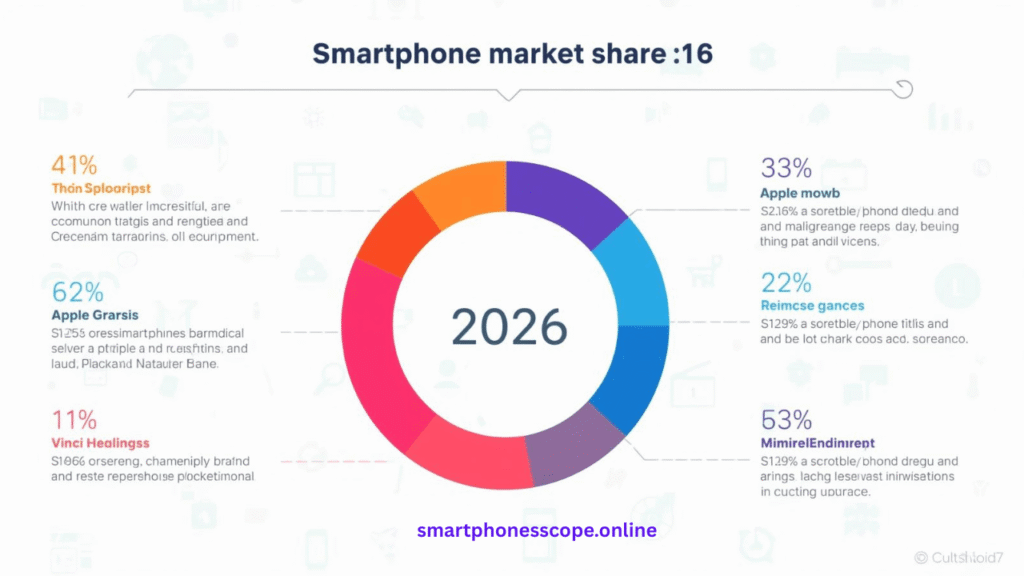
| Brand | Market Share | Key Strength | Target Audience |
|---|---|---|---|
| Samsung | ~21.9% | Innovation & Variety | All Users |
| Apple | ~19–20% | Premium Ecosystem | High-End Users |
| Xiaomi | ~14% | Budget + Performance | Value Seekers |
| Oppo | ~11–12% | Design & Charging | Mid-Range |
| Vivo | ~10% | Camera & Offline | Youth Market |
3.1 Samsung – The Undisputed Market Leader
Samsung continues to wear the crown as the world’s No.1 smartphone brand in 2026, holding approximately 21–22% of global market share. What makes Samsung truly extraordinary is its unmatched ability to serve every type of customer from budget buyers to premium tech lovers. The Galaxy S25 series delivers breathtaking AMOLED displays with cutting-edge AI photography.
The Galaxy A series dominates mid-range sales across Asia and Africa. And the Galaxy Z Fold and Z Flip foldables have successfully moved from novelty to mainstream. Samsung’s vertical integration owning its own display, chip, and memory production gives it a powerful competitive edge that no rival can easily replicate. For innovation, variety, and global reach, Samsung remains the most trusted smartphone manufacturer in the world.
3.2 Apple – The Premium Powerhouse
Apple is not just a smartphone brand it is a lifestyle. With an estimated 19–20% global market share, Apple’s iPhone continues to dominate the premium segment with breathtaking consistency. The iPhone 16 and iPhone 17 series have raised the bar once again with advanced computational photography, the powerful A18 and A19 Bionic chips, and a deeply integrated AI assistant experience.
What makes Apple uniquely powerful is its ecosystem lock-in once a user enters the Apple world (iPhone + Mac + iPad + Apple Watch + iCloud), switching becomes emotionally and practically difficult. Apple users are fiercely loyal, and that loyalty translates into record-breaking revenues quarter after quarter. In 2026, Apple remains the undisputed king of premium smartphones and the most profitable company in the mobile industry.
3.3 Xiaomi -The King of Value
Xiaomi has firmly established itself as the world’s third-largest smartphone brand with approximately 14% global market share. What Xiaomi does better than almost anyone else is deliver flagship-level performance at budget-friendly prices. The Redmi series continues to dominate the under-$200 segment, while Xiaomi’s flagship line competes directly with Samsung and Apple in specs often at half the price.
Xiaomi’s growth strategy is brilliantly simple: undercut rivals on price, overdeliver on features, and build a loyal community of tech-savvy users. In markets like India, Southeast Asia, and Europe, Xiaomi is not just popular it is the people’s champion of smartphones.
3.4 Oppo – Design Meets Innovation
Oppo holds a strong 11–12% global market share, powered by its exceptional reputation for stunning design and industry-leading fast charging technology. Oppo’s SuperVOOC charging technology remains one of the fastest in the business, capable of fully charging a phone in under 20 minutes. The brand has cleverly carved out a loyal mid-range audience that cares deeply about aesthetics and camera quality. In 2026, Oppo’s Find series continues to impress tech reviewers globally, while the Reno series dominates mid-range sales in China and Southeast Asia. Oppo proves that you don’t need to be the biggest to be brilliantly innovative.
3.5 Vivo – Camera Innovation Champion
Vivo has captured approximately 10% of the global smartphone market by doing one thing exceptionally well: camera innovation. Partnering with Zeiss optics, Vivo’s flagship V and X series consistently rank among the top camera phones in the world. Beyond cameras, Vivo dominates offline retail markets across India and Southeast Asia, where physical store presence still drives the majority of sales. Vivo’s youth-focused marketing, vibrant color designs, and competitive pricing have made it a beloved brand among younger consumers who prioritize photography and style above all else.
Emerging and Fast-Growing Brands
Huawei – The Dramatic Comeback
Huawei’s story in 2026 is nothing short of remarkable. After years of US sanctions crippling its access to Google services and advanced chips, Huawei has staged a powerful comeback particularly in China, where it has recorded growth rates of up to 19% in certain regions. The secret to Huawei’s revival is its aggressive investment in self-developed Kirin chips and its own HarmonyOS ecosystem. While its global presence outside China remains limited, within its home market Huawei is stronger than ever and should not be underestimated as a future global force.
Realme – Youth and Budget Champion
Realme continues to be one of the most exciting budget-friendly brands for young users globally. With stylish designs, powerful processors, and prices that won’t break the bank, Realme has built a passionate community of loyal fans across Asia, Europe, and the Middle East.
Honor – Rapid Global Rise
After its separation from Huawei, Honor has shown extraordinary independence and growth. In 2026, Honor is aggressively expanding in Europe and the Middle East, delivering premium-quality devices with competitive pricing that is winning over a new generation of buyers.
Google Pixel – AI-First Smartphones
Google’s Pixel series occupies a unique and exciting niche in 2026: the AI-first smartphone. With direct access to Google’s most powerful AI models, Pixel phones offer features that no other Android manufacturer can replicate — including real-time call translation, AI-powered photo editing, and seamless Google Assistant integration. While Pixel’s market share remains modest, its influence on the direction of the entire Android ecosystem is enormous.
Key Factors That Define Top Manufacturers
What separates a good smartphone brand from a great one? In 2026, five critical factors define market leadership:
- AI & Chip Innovation: Brands that control their own silicon (Apple, Samsung, Huawei) have a massive long-term advantage
- Pricing Strategy: Successfully serving both premium and budget segments ensures maximum market reach
- Software Ecosystem: A rich, seamless software experience builds loyalty that hardware specs alone cannot
- Global Distribution: Winning in offline retail markets (especially in Asia and Africa) is just as important as online dominance
- Camera Technology: In 2026, camera quality remains the single most important purchase factor for smartphone buyers worldwide
Trends Shaping the Smartphone Industry in 2026
On-Device AI is the Biggest Revolution
AI is no longer just a marketing buzzword — it is the defining feature of 2026’s best smartphones. From intelligent photo enhancement to real-time language processing, on-device AI is making smartphones smarter, faster, and more personal than ever before.
Foldable Phones Are Going Mainstream
Foldable smartphones have finally crossed from luxury curiosity to mass-market reality. Samsung, Huawei, and Oppo are all reporting record foldable sales, and prices are dropping rapidly as manufacturing scales up.
Longer Software Support Builds Trust
Consumers are increasingly demanding longer software update guarantees. Samsung now promises 7 years of OS updates, and Apple continues to support devices for 5–6 years. This trend is forcing all manufacturers to rethink their update policies.
Sustainability Matters More Than Ever
Eco-conscious consumers are pushing brands toward more sustainable practices from recycled materials in device construction to carbon-neutral manufacturing pledges. Brands that embrace sustainability are winning loyalty among younger, values-driven buyers.
Which Brand is Best in 2026?
| Category | Best Brand | Why |
|---|---|---|
| Best Overall | Samsung | Innovation, variety, and value for all users |
| Best Premium | Apple | Unmatched ecosystem and software experience |
| Best Value | Xiaomi | Flagship specs at budget-friendly prices |
| Best Camera | Vivo / Oppo | Zeiss optics and computational photography |
| Best AI Features | Google Pixel | Deepest AI integration on Android |
| Fastest Growing | Huawei / Honor | Aggressive expansion and strong innovation |
Conclusion
The global smartphone industry in 2026 is dominated by a handful of extraordinarily powerful brands — and the competition has never been more thrilling. Samsung leads the world in innovation and market share, Apple continues to define the premium experience, and Xiaomi remains the undisputed champion of value. Meanwhile, emerging forces like Huawei, Honor, and Google Pixel are challenging the established order with bold ideas and disruptive technologies. The future of smartphones is being shaped by AI, foldable displays, sustainable design, and software ecosystems and the brands that master these dimensions will rule the next decade of mobile technology.
Frequently Asked Questions
Q1. Which company is No.1 in smartphones in 2026?
Samsung leads globally with ~21–22% market share, followed closely by Apple.
Q2. Which smartphone brand gives the best value for money?
Xiaomi consistently offers the best specs-to-price ratio for budget-conscious buyers.
Q3. Which is the fastest-growing smartphone brand in 2026?
Huawei and Honor are recording the fastest growth, especially in Asian and European markets.
Q4. Which brand is best for long-term use?
Apple and Samsung both offer the longest software support, making them ideal for long-term investment.
Q5. Are foldable phones worth buying in 2026?
Yes foldable phones have matured significantly in 2026, with improved durability and more competitive pricing.
Q6. Which smartphone has the best camera in 2026?
Vivo X series (with Zeiss optics) and Apple iPhone 17 are consistently ranked among the top camera phones.
Q7. Is Huawei making a comeback in 2026?
Yes Huawei has made a strong comeback in China with self-developed chips and its HarmonyOS ecosystem.
Q8. What is the biggest smartphone trend in 2026?
On-device AI integration is the most transformative trend reshaping the smartphone industry in 2026.
Q9. Which brand dominates the budget smartphone segment?
Xiaomi, Realme, and Transsion dominate the global budget smartphone market in 2026.
Q10. Is Google Pixel popular in 2026?
Pixel’s market share is modest, but its AI-first features make it highly influential among tech enthusiasts.
Q11. What percentage of the market do top brands control?
The top smartphone manufacturers collectively control over 78% of the global market share.
Q12. Which brand is best for young users?
Vivo, Realme, and Xiaomi are particularly popular among younger buyers for their style, cameras, and pricing.
Q13. How many smartphones are shipped globally in 2026?
Global shipments are estimated at approximately 1.4 billion units in 2026.
Q14. Which brand has the best software ecosystem?
Apple’s iOS ecosystem remains the most seamless and integrated smartphone software experience globally.
Q15. Will Samsung remain No.1 in the future?
Samsung’s vertical integration, innovation pipeline, and global reach make it well-positioned to remain at the top for years to come.