Are you still carrying a smartphone that slows you down instead of powering you up? In 2026, the best phone for business is no longer just a communication device — it’s your mobile command center, your AI assistant, your secure vault, and your productivity hub, all in one pocket-sized package. Whether you’re a busy executive rushing between boardroom meetings, an entrepreneur managing a remote team, or a field sales rep closing deals on the go, choosing the wrong business smartphone can silently cost you hours, deals, and data security. This guide breaks down the top business smartphones of 2026 comparing Apple, Samsung, and Google so you can make a confident, informed decision that truly works for your professional life.
Why Your Business Phone Choice Matters More Than Ever
Your smartphone touches every part of your work emails, video calls, documents, payments, and client communication. A wrong choice means laggy apps, weak security, and a dead battery at the worst moment. The right choice? Unstoppable productivity. In 2026, with AI tools now deeply integrated into everyday apps, the gap between a great business phone and a mediocre one has never been wider.
Key Features to Look for in a Business Smartphone
Before we dive into specific models, let’s understand what separates a great business phone from just another flagship.

for business productivity in modern office 2026
2.1 Security & Privacy – Your Digital Armor
Robust security and advanced AI features are paramount for business leaders. Devices with dedicated hardware encryption chips and multi-layered security architectures are essential, safeguarding against cyber threats. Look for:
- Biometric authentication (Face ID, under-display fingerprint)
- Enterprise security platforms like Samsung Knox or Apple’s Secure Enclave
- Hardware encryption chips (e.g., Google’s Titan M2)
- MDM (Mobile Device Management) support for IT teams
2.2 Software Updates & Longevity – Think Long-Term
A phone that stops receiving updates becomes a security liability. The iPhone 17 Pro guarantees seven years of software updates, while Samsung’s Galaxy S25 FE also offers seven years of update. For a device you’ll rely on for 2–3 years, long-term support is non-negotiable.
2.3 Performance & Multitasking — No More Lag
The iPhone 17 Pro runs on the A19 Pro chip and delivers outstanding performance for demanding business apps.For Android users, the Galaxy S25 Ultra features a Snapdragon 8 Elite processor that handles complex AI workloads with remarkable efficiency. More RAM and faster storage mean smoother video calls, faster file transfers, and zero frustration.
2.4 Battery Life & Charging – Power Through Your Day
The iPhone 17multi-layered security over 17 hours of battery life, while the Samsung Galaxy S26 Ultra can hit 77% charge in just 30 minutes. For professionals on the move, all-day battery combined with fast charging is a must-have, not a nice-to-have.
2.5 Productivity Features – Work Smarter
The S Pen on the Galaxy S25 Ultra enhances note-taking and document management, while Samsung DeX transforms it into a desktop-like experience. AI tools for email summaries, meeting transcription, and smart replies are now standard in top-tier business phones.
2.6 Ecosystem & Compatibility 17multi-layered security
The iPhone 17 Pro offers excellent MDM support through Apple Business Manager and seamless integration with Mac, iPad, and Apple Watch. Android phones shine with Google Workspace and Microsoft 365. Pick a phone that fits your existing tech stack.
Top Business Phones Feature Comparison (2026)
| Phone | Best For | Processor | Security | Updates | S Pen | Price Range |
|---|---|---|---|---|---|---|
| iPhone 17 Pro | Executives, Apple users | A19 Pro | Secure Enclave | 7 years | ❌ | Premium |
| Samsung Galaxy S25 Ultra | Power users, field teams | Snapdragon 8 Elite | Knox | 7 years | ✅ | Premium |
| Google Pixel 10 Pro | AI productivity, Workspace | Tensor G5 | Titan M2 | 7 years | ❌ | Premium |
| Samsung Galaxy Z Fold 7 | Multitasking pros | Snapdragon 8 Elite | Knox | 7 years | ✅ | Ultra-Premium |
| OnePlus 15 | Value-conscious pros | Snapdragon 8 Elite | Standard | 4 years | ❌ | Mid-Premium |
Best Phones for Business in 2026 -Top Picks
3.1 Apple iPhone 17 Pro – Best Overall Business Phone
The iPhone 17 Pro is the gold standard for business professionals who want the complete package – security, performance, longevity, and ecosystem harmony.
Apple’s iPhone 17 Pro series remains the gold standard for business professionals. With industry-leading security, excellent app stability, and tight integration with macOS and iPadOS, it’s ideal for executives and enterprises already invested in Apple’s ecosystem.
Why it wins for business:
- A19 Pro chip handles any app without breaking a sweat
- 7 years of guaranteed iOS updates
- Apple Business Manager for enterprise IT management
- Face ID + Secure Enclave for airtight data protection
- Seamless Handoff, AirDrop, and Universal Control with Mac/iPad
Ideal for: Executives, lawyers, consultants, finance professionals
Verdict: If you want one phone that does everything brilliantly and keeps your data bulletproof, the iPhone 17 Pro is your answer.
3.2 Samsung Galaxy S25 Ultra – Best for Power Users
For professionals who live in their phone and need it to do everything, the Galaxy S25 Ultra is a beast.
The Samsung Galaxy S25 Ultra is a high-performance Android flagship targeting business leaders who require superior multitasking. The integrated S Pen allows for precise note-taking on its large AMOLED display. Samsung DeX functionality provides a desktop-like experience, allowing users to connect to an external monitor. The robust Samsung Knox platform offers defense-grade security, including MDM support for enterprise-level protection.
Why it wins for business:
- Built-in S Pen for contracts, annotations, and quick notes
- Samsung DeX turns your phone into a full desktop
- Knox security trusted by governments and enterprises
- 200MP camera for crisp video calls and document scanning
Ideal for: Sales managers, field workers, entrepreneurs, heavy multitaskers
Verdict: The Swiss Army knife of business phones powerful, versatile, and enterprise-ready.
3.3 Google Pixel 10 Pro -Best for AI Productivity
The Pixel 10 Pro is a productivity beast from screening calls to translating conversations in your own voice. If your business runs on Google Workspace, this is your perfect match.
Why it wins for business:
- Gemini AI deeply integrated for email summaries, call transcripts, and smart replies
- Titan M2 chip for hardware-level security
- 7 years of OS and security updates directly from Google
- Clean Android experience with zero bloatware
Ideal for: Startups, remote teams, Google Workspace-heavy businesses, solo entrepreneurs
Verdict: The smartest phone for professionals who want AI to handle the boring stuff so they can focus on growth.
3.4 Samsung Galaxy Z Fold 7 – Best for Multitasking
The Samsung Galaxy Z Fold 7 is a marvel of engineering that’s just 4.2mm thick when unfolded, and it boasts the same 200MP main camera as the Galaxy S25 Ultra.
Why it wins for business:
- Tablet-sized inner screen for reviewing documents and spreadsheets
- Run 3 apps simultaneously side-by-side
- Perfect for video calls while taking notes at the same time
- Premium look that makes a strong impression in meetings
Ideal for: C-suite executives, consultants, anyone who hates switching between phone and tablet
Verdict: The future of mobile productivity, wrapped in a phone that fits in your pocket.
3.5 OnePlus 15 – Best Value for Professionals
Not every professional needs to spend $1,200 on a phone. The OnePlus 15 delivers flagship-level performance at a significantly lower price.
Why it wins for business:
- Snapdragon 8 Elite processor for lag-free multitasking
- Exceptional fast charging (100W+)
- Clean OxygenOS with minimal distractions
- Strong camera system for video calls and documentation
Ideal for: Small business owners, early-career professionals, cost-conscious teams equipping multiple staff
Verdict: Premium performance without the premium price tag a genuinely smart business decision.
iPhone vs Android for Business – Which Side Are You On?
| Factor | iPhone (iOS) | Android |
|---|---|---|
| Security | ⭐⭐⭐⭐⭐ Industry-leading | ⭐⭐⭐⭐ (Samsung Knox = excellent) |
| Customization | Limited | Highly flexible |
| Ecosystem | Apple-only but seamless | Works with everything |
| Multitasking | Good | Better (split screen, DeX) |
| AI Features | Apple Intelligence | Gemini, Galaxy AI |
| Update Longevity | 7 years | 4–7 years (varies) |
| Price Range | Premium only | Budget to ultra-premium |
Bottom line: iPhone wins on security and simplicity. Android wins on flexibility and features. Neither is wrong — it depends entirely on your workflow.
Best Business Phones by Use Case
For Executives
→ iPhone 17 Pro Max – The prestige, security, and seamless ecosystem combination makes it the boardroom-ready choice. Nothing communicates professionalism like a flawlessly performing device.
For Entrepreneurs & Small Business Owners
→ Google Pixel 10 Pro — AI tools that automate tasks, tight Google Workspace integration, and clean software that won’t waste your precious time.
For Field Workers & Sales Teams
→ Samsung Galaxy S25 Ultra or OnePlus 15 – The S25 Ultra’s S Pen handles contract signing and document annotation on-site. OnePlus 15 keeps costs down when equipping a large team.
For Multitasking Professionals
→ Samsung Galaxy Z Fold 7 -The only phone that genuinely replaces a tablet for spreadsheet reviews, multi-app work, and presentation prep.
Budget vs Premium Business Phones
| Tier | Options | Who Should Buy |
|---|---|---|
| Budget (Under $400) | Samsung Galaxy A56, Pixel 9a | Small teams, entry-level staff |
| Mid-Range ($400–$800) | OnePlus 15, Samsung Galaxy S25 FE | Professionals wanting performance without overspending |
| Premium ($800–$1,200) | iPhone 17 Pro, Pixel 10 Pro, S25 Ultra | Executives, decision-makers, power users |
| Ultra-Premium ($1,500+) | Galaxy Z Fold 7 | Multitasking pros who need phone + tablet in one |
When to invest in premium: If your phone directly impacts client interactions, business security, or daily decision-making — the cost of a premium phone pays for itself quickly in time saved and problems avoided.
Common Mistakes to Avoid When Choosing a Business Phone
1. Ignoring software update commitments — A phone with only 2–3 years of updates is a ticking security time bomb for a business.
2. Buying cheap at the cost of security — Low-cost phones from lesser-known brands often lack enterprise security certifications, putting your company data at serious risk.
3. Not checking ecosystem compatibility — An Android phone that fights with your Mac-heavy office, or an iPhone in a Google Workspace-only company, creates daily frustration.
4. Overlooking battery life — A phone that dies at 3 PM is not a business phone, it’s a liability.
5. Ignoring MDM support — If IT can’t manage your device remotely, your company’s security posture suffers.
Final Verdict
| Award | Winner |
|---|---|
| 🏆 Best Overall | Apple iPhone 17 Pro |
| 🤖 Best Android | Samsung Galaxy S25 Ultra |
| 🧠 Best AI Phone | Google Pixel 10 Pro |
| 📱 Best Multitasking | Samsung Galaxy Z Fold 7 |
| 💰 Best Value | OnePlus 15 |
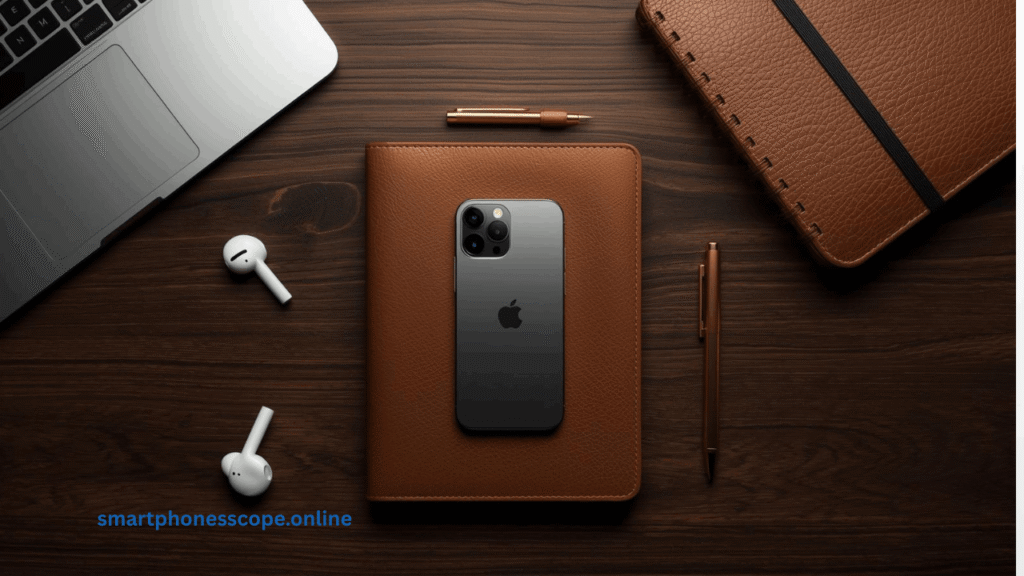
executive desk with MacBook and leather planner
FAQs
Q1: Which phone is best for business security?
Apple iPhone 17 Pro and Samsung Galaxy S25 Ultra (Knox) are the top choices for enterprise-grade security.
Q2: Is Android good for business use?
Absolutely especially Samsung (Knox security) and Google Pixel (Titan M2 + 7-year updates).
Q3: Which phone is best for multitasking?
Samsung Galaxy Z Fold 7, hands down its foldable screen lets you run multiple apps simultaneously.
Q4: Which phone has the best AI features for work?
Google Pixel 10 Pro leads with Gemini AI integration for call summaries, smart replies, and translation.
Q5: What’s a good business phone under $500?
Samsung Galaxy A56 and Google Pixel 9a both deliver excellent security and performance at budget-friendly prices.
Q6: iPhone or Samsung for business?
iPhone for security and ecosystem simplicity; Samsung for power, flexibility, and multitasking features.
Q7: How long should a business phone last?
Aim for at least 3–4 years. Choose phones with 7-year update commitments for maximum ROI.
Q8: Is the S Pen useful for business?
Extremely for contract signing, document annotation, quick sketches, and precise on-screen navigation.
Q9: Which phone works best with Microsoft 365?
Both iOS and Android work excellently with Microsoft 365. Samsung DeX adds a desktop-level experience.
Q10: Can I use a foldable phone for business?
Yes the Galaxy Z Fold 7 is specifically excellent for document review, spreadsheets, and video calls.
Q11: Which phone is best for remote teams?
Google Pixel 10 Pro for Google Workspace teams; iPhone 17 Pro for Apple-centric organizations.
Q12: Do budget phones work for business?
For basic tasks, yes. But they often lack enterprise security features and long update support.
Q13: Is OnePlus good for business use?
For value-conscious professionals, yes strong performance, fast charging, and clean software.
Q14: What processor is best for business tasks?
Apple A19 Pro and Snapdragon 8 Elite are the fastest in 2026 — both handle any business workload effortlessly.
Q15: Should I choose 5G for a business phone?
Absolutely in 2026, 5G is essential for fast data, seamless video conferencing, and future-proofing your device.